The 1-2-3 Outfit Formula: How to Get Dressed in 5 Minutes Without Looking Like It
One base, two layers, three finishing touches. The outfit formula that works for every occasion — and takes five minutes to put on.
It’s 7:52 AM. You have eight minutes before you need to leave. You’ve tried three tops. The fourth is worse. You end up in the first one, vaguely defeated, late, and wearing something that’s “fine.”
This does not need to be your life.
You just need a formula.
Why “think less” is the real style hack
Here’s something the best-dressed people you know probably won’t tell you, because they don’t consciously know it themselves: they’re not spending more time on outfits than you are. They’re spending less.
They’re not starting from scratch every morning, evaluating every piece in the closet against every other piece, worrying whether the vibe is right. They’re executing a pattern. A structure. A shortcut their brain already trusts. W Magazine ran a great feature on this — a portrait series of people like Fran Lebowitz and Peter Marino who wear essentially the same thing every day, as a deliberate choice. The piece calls consistency “the ultimate expression of personal style.” The point isn’t that you should wear the same thing forever. The point is that what they’ve done is reduce dressing to a template, and everyone reads it as taste. And when they reach for their clothes, most of the work is already done.
This is actually consistent with a whole body of research on decision fatigue — the finding that our ability to make good decisions wears down as we make more of them. Which is why so many people who think hard for a living (Obama, Jobs, Zuckerberg, every chef you’ve ever respected) go out of their way to automate small morning choices. Clothes are one of the easiest to automate. You just need a template.
The template is: 1 base + 2 layers + 3 finishing touches.
That’s the whole thing. Once it clicks, you’ll use it for years.
The formula, explained
1 base is your foundation piece. Usually the bottom half — jeans, trousers, a skirt. Neutral and solid is ideal for maximum flexibility, because the base doesn’t have to do much stylistic work. It just has to be there.
2 layers is one top plus one “over.” The top is your tee, blouse, bodysuit, tank, whatever sits closest to your skin. The over is your jacket, blazer, cardigan, or oversized button-down. Two layers is the sweet spot — one feels unfinished, three starts to look fussy. This is the part of the outfit where most of your personal style shows up.
3 finishing touches is shoes + bag + one accessory. That’s it. An earring counts as one. A hat counts as one. A scarf counts as one. Do not stack — pick one. This is where “expensive-looking” lives, and also where most people accidentally kill an otherwise good outfit by piling on three necklaces when one would have been better. There’s a whole post on why fewer pieces read more expensive — the formula closes that failure mode by capping you at three, by design.
Six pieces, total. Always.
Three outfits, same formula
The best thing about this formula is how differently it plays out depending on which pieces you slot in. Same skeleton, wildly different energy. Here are three versions across entirely different occasions.
Example 1: Casual weekend
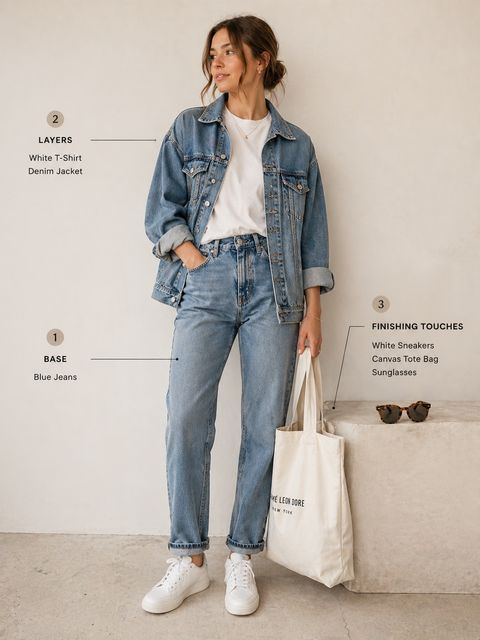
- Base: straight-leg jeans
- Layers: white tee + oversized denim or canvas jacket
- Finishers: clean white sneakers + canvas tote + sunglasses
Every piece is low-effort, but the structure makes it look intentional. Without the jacket, it’s two pieces and feels empty. Without the finishers, it’s three pieces and feels like gym clothes. Add the formula and it reads as a put-together weekend look without you having thought about it.
Example 2: Workday / elevated
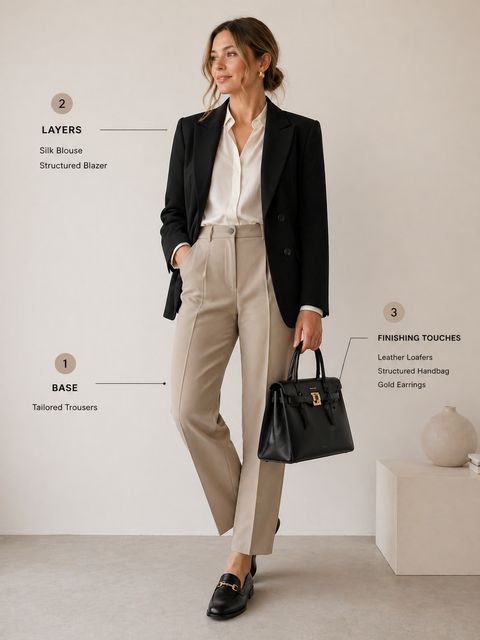
- Base: tailored trousers
- Layers: silk or silk-feel blouse + blazer
- Finishers: loafers + structured bag + small gold earrings
Same skeleton, completely different energy. The blazer and blouse do the heavy lifting here — the trousers are boring on purpose, because they’re the base. Their job is to stay out of the way while the top half communicates. This is the version you wear when you want to be taken seriously without thinking about it.
Example 3: Night out
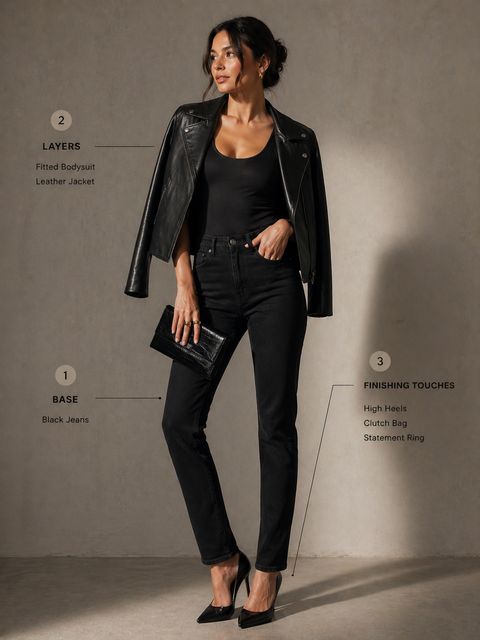
- Base: black jeans or leather pants
- Layers: fitted bodysuit + leather jacket
- Finishers: heels + small clutch + statement ring
The formula doesn’t care whether you’re going to brunch or a bar. Same six slots, entirely different output. Here the layers get tighter and more charged — the leather jacket is doing some actual stylistic work instead of just adding volume — and the finishers lean sharper. One statement ring instead of stacked rings plus big earrings plus a chain.
Why this formula works
A few reasons, all of them subtle.
It forces completeness. Nothing is missing; nothing is extra. Most “I look off today” moments come from either under-dressing the outfit (no finishers) or over-stuffing it (five finishers). Six slots, filled exactly once, closes both failure modes.
It removes decisions. You’re not starting from zero — you’re filling slots. Once you know you need one base, two layers, and three finishers, the question shifts from “what should I wear?” (infinite) to “what am I using for each slot?” (finite). That’s the difference between decision paralysis and decision flow.
It’s stylistically neutral. Minimalist people, maximalist people, and everyone in between can run it. The formula doesn’t specify which jeans, which blazer, or which bag — it just specifies how many of each. Your taste fills the rest.
It scales to the occasion automatically. Same six slots, different pieces, and the outfit shifts from weekend to workday to night out without restructuring. Once you have the formula in your head, you can do the whole translation in about fifteen seconds.
When to break the formula
The formula is scaffolding, not law. A few legitimate variants:
- Dresses and jumpsuits compress “base + top” into one piece. The formula becomes 1 base + 1 layer + 3 finishers. Same logic, one fewer slot.
- Hot weather often lets you drop the over-layer entirely. 1 base + 1 top + 3 finishers is a perfectly valid summer version.
- Formal events still run the formula, but each piece has to do more. A formal dress is your base + top; the layers collapse into one statement piece (a tailored coat, or no layer at all); the finishers get more refined (heels, clutch, one piece of jewelry).
The point isn’t rigid adherence. The point is having a structure you can lean on when you don’t have the time or the mental energy to invent an outfit from scratch. Most mornings, you don’t.
From formula to wardrobe
The 1-2-3 formula tells you how many pieces go in an outfit. It doesn’t tell you which ones. That part has to come from you — your colors, your silhouettes, your vibe, the mood of the day. For most people, that’s the part they get stuck on. Not “how many,” but “which.”
That’s the part fitté is built for. It takes the inspiration you’ve already been saving — your Pinterest boards, your screenshots, the accounts you follow — and turns it into specific rules for which pieces actually fit the formula for you. Which jeans are your jeans. Which blazer is your blazer. Which finisher is the one your style actually calls for. The formula provides the structure; fitté provides the fill-in.
If you want the deeper version of that, start with the 20-minute exercise on finding your personal style first. Then come back and apply the formula. The combination is disproportionately powerful.
Stop deciding. Start filling in the blanks. Your mornings will thank you.