
Blog /
How to Find Your Personal Style (Even If You Have No Idea What It Is)
You know what you like when you see it — but you can't explain it. Here's how to turn that visual intuition into a style identity you can actually use.
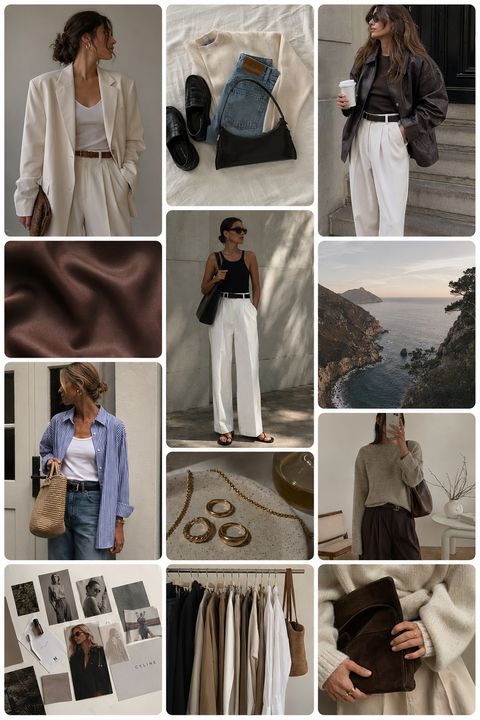
You have 847 saved pins on Pinterest. A camera roll full of outfit screenshots. A follow list of 30 style accounts. And when someone asks what your style is, you say “I don’t know… kind of casual? I guess?”
You’re not confused. You have a very specific style. It’s right there in everything you’ve saved. You just haven’t looked at it the right way yet.
This post is about how to actually look.
Why “what’s your style?” is the wrong question
Most style advice starts by asking you to define yourself in categories. Classic. Boho. Streetwear. Coastal grandmother. Clean girl. Dark academia. You pick one, the story goes, and now you know what to wear.
The reason this never quite works is that real style is almost never one category. It’s a blend. You might love the ease of coastal grandmother but only in cooler tones. You might like streetwear silhouettes with softer colors than the category usually uses. The second you pick a label, you have to start ignoring the half of your taste that doesn’t fit it.
There’s a better question, and it’s almost embarrassingly simple:
What do I keep saving?
Taste shows up in patterns of attraction, not in self-assigned categories. The things you return to — the images, the colors, the shapes, the vibes — those are already telling you who you are, stylistically. You just have to be willing to look at them as a group instead of one at a time.
There’s actually a whole body of research on this. Psychologists call it the mere-exposure effect — we develop real, measurable preferences for things we keep encountering, often without realizing it. Your saved pins are basically a map of those preferences. The data is already there. You just haven’t graphed it yet.
The 20-minute exercise that actually works
Here’s the exercise. You can do it in one sitting, on your couch, with nothing but your phone.
Step 1: Gather at least 30 images you’ve saved recently. Pinterest pins, Instagram saves, TikTok screenshots, photos you’ve sent to friends going “omg THIS.” Don’t overthink which ones belong. More is better than fewer. Thirty is the minimum; fifty is ideal.
Step 2: Put them all in one place. A Pinterest board, a shared album, a screenshot grid, a Notes app page — whatever’s easiest. The key is that you can see them all at once, not scroll through them one by one.
Step 3: Look at them as a group, not individually. Squint slightly. (Really — squinting blurs the detail and lets the overall pattern come forward.) You’re not evaluating any single image. You’re looking for what they have in common.
Step 4: Ask four questions. This is the whole exercise.
- What colors keep showing up? Be specific. “Neutrals” is too vague. Is it warm neutrals (cream, camel, chocolate) or cold ones (grey, stone, ecru)? Is there a lot of black? An accent color that keeps appearing — rust, forest green, deep red?
- What shapes dominate? Oversized or fitted? Flowy or structured? High-waisted or low? Long or cropped? If 40 of your 50 images are loose silhouettes, that’s a signal.
- What feeling do they share? Relaxed, polished, edgy, soft, sharp, romantic, minimal, playful. One word. Don’t overthink it.
- What’s never there? This matters as much as what is. Maybe you never save anything bright. Never anything ultra-fitted. Never anything with logos. The absences are part of your taste.
The answers to those four questions are your style profile. That’s it. You don’t need a test. You need to look.
What to do with the pattern once you see it
Seeing the pattern is the interesting part. Using it is the useful part.
Write your style down in one sentence. This is the move that turns a vague intuition into something you can actually apply. An example: “Warm neutrals, oversized silhouettes, relaxed fits, never bright colors or bodycon.” That’s a real style statement. It’s specific enough to make decisions with and loose enough to leave room for range.
Yours might be: “Cold tones, structured shoulders, one piece of gold jewelry, never pastels.” Or: “Moody darks, vintage shapes, textured fabric, no minimalism.” There’s no right answer — just a true one.
Use it as a filter for everything. Getting dressed: does this outfit fit the sentence? Shopping: does this piece fit the sentence? Styling: does this accessory fit the sentence? If yes, proceed. If no, the answer is probably no, even if the piece is nice. If you want a daily template to drop your sentence into, the 1-2-3 outfit formula is the simplest one — your style picks the pieces, the formula picks how many.
This is the underrated benefit of actually naming your style. There’s a good piece in Psyche about this — about how the outfits that genuinely work for us aren’t the ones that look right in the mirror, they’re the ones that make us feel like ourselves walking around in the world. The gap between “a nice piece” and “a nice piece that’s you” isn’t a small thing. It’s the whole game.
Keep revisiting and refining. Your style evolves. The sentence isn’t permanent — it’s a snapshot of current you. Redo the exercise once a year, or whenever something feels off. The pattern will have shifted, and the new version of the sentence will catch it.
The three mistakes people make
Even with the method above, there are a few traps. Watch for these.
Mistake 1: Confusing “what I admire” with “what suits me.” You can deeply love minimalist Scandinavian style and still look your best in richer, warmer pieces. You can follow ten streetwear accounts and realize none of those outfits ever feel right on your body. Pay attention to what you save AND wear well — not just what looks cool on someone else. Admiration and personal style are different data points.
Mistake 2: Trying to copy a specific person’s style wholesale. Pick signals, not outfits. If your favorite style account has a great color palette, borrow the palette. If she has a particular way of layering, borrow the method. You can steal an approach without replicating the exact jacket she’s wearing. Wholesale copies almost never translate — your body, your life, your face are different from hers, and something gets lost in the replication.
Mistake 3: Thinking style has to be one thing. Most people have 2-3 style modes. Work vs. weekend. Calm vs. going-out. Summer vs. winter. That’s not a contradiction — that’s just real life. Define each one separately. You can have a “sharp, tailored, tonal” mode for work and a “oversized, soft, worn-in” mode for weekends, and both of them are you. One wardrobe, a few settings.
Where this gets easier
If this exercise sounds useful but also kind of annoying to do manually — that’s literally why we built fitté. You upload the images you’ve already been saving, and fitté does the pattern-finding part for you: pulling out your color tendencies, your silhouette preferences, your aesthetic rules, and what’s distinctly not your style. Then it becomes a filter you can carry around — one that tells you whether a piece fits the real pattern in your taste, not the mood you were in at checkout.
It’s not required. The exercise above works on its own, with nothing but a Pinterest board and some squinting. fitté just makes it faster, and it keeps the answer in your pocket for every outfit and shopping decision after that.
Closing
Your style isn’t hiding. It’s just un-named.
Give it twenty minutes and a hard look at what you’ve saved, and you’ll know more about your taste than any quiz will ever tell you. The pattern has been there the whole time. You were just looking at the pins one by one instead of all together.
Go look at them all together.