How to Make Cheap Clothes Look Expensive: 7 Styling Tricks That Actually Work
The most expensive-looking women in the room aren't wearing the most expensive clothes. They're doing 7 specific things. Here's every one.
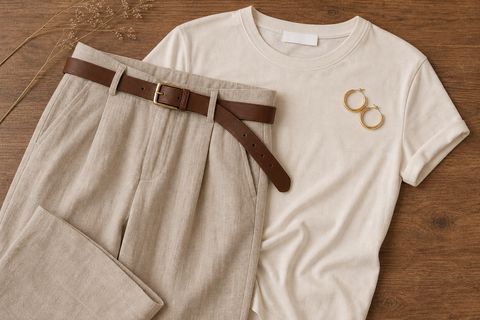
Walk into any expensive neighborhood café and you’ll spot them immediately — the people who look put-together in a way that reads as “she spends a lot on clothes.” Except half the time, she doesn’t. She’s wearing a $15 tee and $40 jeans. The difference isn’t what she bought. It’s 7 things she’s doing that you can start doing tomorrow.
None of them cost money.
Why price isn’t what makes clothes look expensive
Here’s a quick myth to bust: expensive fabrics matter much less than most people think. A $200 cashmere sweater that fits wrong will read cheaper than a $30 cotton one that fits right. The eye can’t actually see fabric composition across a room. What it can see is fit, drape, proportion, color coherence, and the general absence of visual noise.
Those are the things “expensive” actually looks like. And every one of them is a decision, not a purchase.
The seven tricks below are the decisions the well-dressed are quietly making. They work on fast fashion, thrift finds, hand-me-downs, and things you’ve had in your closet for five years. They don’t require a budget. They require a small shift in what you pay attention to.
Trick 1: Tailor everything, even cheap stuff
This is the single biggest lever, and most people skip it because it feels like something you do only for expensive clothes.
A $15 hem on a $30 pair of pants changes the silhouette more than buying $200 pants. Cheap clothes almost always fail on fit, not fabric — the fabric problem mostly disappears once the fit is right. Take in a waist. Shorten sleeves that hit the wrong spot on your wrist. Hem pants to the exact length that works with the shoes you actually wear. These are $10–25 fixes, and they are the closest thing to a style superpower you can buy.
There’s a good piece on this from a personal stylist that puts it bluntly: find a tailor and make them your best friend. She tailors almost every pair of jeans she owns. Not the expensive ones — all of them.
Trick 2: Go monochrome or tonal
Wearing one color family — all cream, all black, all shades of brown, all greys — instantly reads as intentional and high-end. There’s a simple visual reason: the eye reads fewer visual breaks as more luxurious. A single long column of one color is how we’re used to seeing tailoring on expensive people.
The easiest entry point: head-to-toe black or head-to-toe beige. Both are almost impossible to get wrong. Once you’re comfortable with that, you can get more interesting with tonal — all warm browns in different shades (camel trousers, cream top, chocolate jacket, caramel bag), or all cool greys ranging from charcoal to dove.
Trick 3: Match your metals
All gold OR all silver. Never mixed — at least, not until you know exactly what you’re doing.
This extends further than jewelry. It’s belt buckles. Watch cases. Bag hardware. Zippers. Earring backs. Even shoe hardware if there is any. Pick a metal, and make everything visible from the waist up agree with it.
It’s one rule, zero effort, and it upgrades every outfit you put together afterwards.
Trick 4: Invest in one anchor piece
If you’re going to spend money on exactly one thing, spend it here. A structured bag, a clean pair of leather shoes, or a well-cut blazer does more for how expensive an outfit reads than any other single item.
The anchor elevates everything around it. A $40 tee + $60 jeans + a great leather bag reads as a $400 outfit to the casual eye. A $300 dress with an obviously cheap bag does not. One great piece carries the rest; many medium pieces cancel each other out.
Spend here. Save everywhere else.
Trick 5: Iron or steam everything
Wrinkles read as cheap faster than any other single signal — faster than fabric, faster than fit, faster than brand.
A $20 linen shirt that’s been ironed crisp looks more expensive than a $100 one pulled out of a drawer in a wad. A $30 countertop steamer is the best clothing purchase most people never make. Five minutes before you leave the house and every piece you own reads one tier up.
If you do one thing from this list, it can be this. It is genuinely the lowest-effort highest-impact trick here.
Trick 6: Fewer pieces, more intention
Stacked rings. Three necklaces. A scarf and a statement earring and a patterned bag. This is the Instagram outfit — visually loud, hard to photograph, often beautiful in isolation.
The expensive-looking outfit is the opposite. It picks one statement and strips everything else back. Great coat + simple everything else reads more expensive than great coat + chunky boots + statement bag + big earrings + silk scarf, even if every single item is good.
The rule: choose one thing to be the focal point, and let the rest be quiet. If you want a structural version of this — a hard cap on how many pieces you’re allowed — the 1-2-3 outfit formula builds the limit straight into how you assemble the outfit.
Trick 7: Choose colors that don’t scream
Muted, dusty, or deep versions of colors read more expensive than bright, neon, or saturated ones. This is almost a hard rule.
Deep forest green beats kelly green. Dusty rose beats bubblegum pink. Chocolate brown beats tan-with-orange. Oxblood beats fire-engine red. The pattern here isn’t about “only wear neutrals” — it’s about picking the version of a color that’s one step away from the most saturated version of itself.
Fast-fashion brands gravitate toward saturated colors because they photograph well on a rack, at scale, under fluorescent store lighting. Muted colors photograph well on a person. That’s the shift.
This is also, more or less, the entire principle behind quiet luxury — a style category built on muted palettes, understated materials, and the absence of visible branding. The people who actually have money, it turns out, tend to dress in ways that require you to look twice to notice. Your outfit can borrow that logic for free.
The thing most “look expensive” articles get wrong
Here is what almost every listicle on this topic misses: expensive-looking is personal. A piece that looks incredible on your friend might look costumey on you, not because it’s cheap but because it’s not aligned with your style. A structured blazer reads expensive on someone whose whole vibe is tailored. On someone whose whole vibe is oversized and soft, that same blazer looks like a costume — even if it cost $400.
The seven tricks above work universally. They’re the tactical layer. But the strategic layer underneath is knowing which colors, which cuts, and which anchor pieces actually belong to your style, specifically.
This is where a personal style system starts to matter more than any individual trick. Once you know whether your style leans warm or cool, oversized or fitted, minimal or textured, suddenly you’re not guessing which cheap clothes will look expensive. You know which ones will — because you know what “expensive” looks like on you.
If you haven’t done it yet, start with the 20-minute exercise to identify the pattern in what you already save. That’s literally what fitté was built to speed up: it turns the images you’ve been saving into a specific, usable sense of what “expensive on you” means, so the tricks above have something true to attach to.
Closing
None of these tricks involve spending more money. Most of them involve spending less.
Expensive-looking is a skill, not a price tag — and like any skill, the more you practice it the more automatic it gets. A year from now you won’t be consciously running through a checklist. You’ll just reach for the tonal outfit, match your metals without thinking, and steam the shirt on your way out the door. And everyone will wonder where you’ve been shopping.